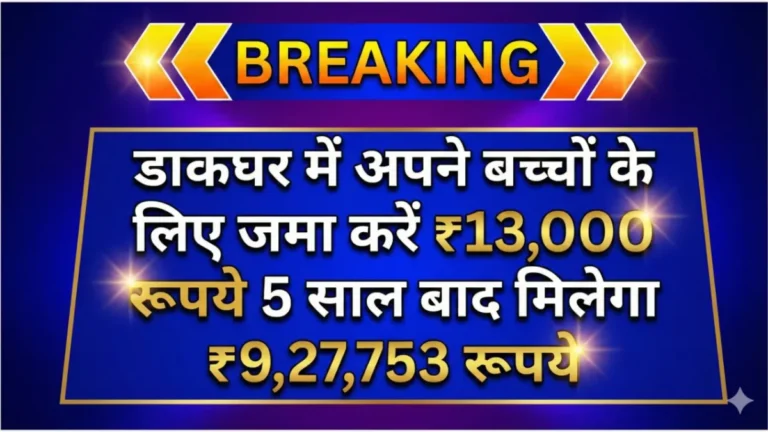
₹13 हजार रुपये जमा करने पर 5 साल बाद मिलेंगे ₹9,27,753 रुपये का रिटर्न Post Office RD Yojana

By depositing ₹13,000, you will receive a return of ₹9,27,753 after 5 years under the Post Office RD Scheme.

Post Office RD Yojana offers a secure monthly savings option where depositing ₹13,000 monthly can yield ₹9,27,753 after 5 years. This government-backed scheme provides guaranteed returns without market risks, making it ideal for salaried individuals and small business owners seeking steady wealth creation. The scheme operates on a 6.7% annual interest rate with quarterly compounding, ensuring your money grows consistently over time.

How Post Office RD Scheme Works

The Post Office Recurring Deposit runs for 5 years or 60 months. Currently, the scheme offers approximately 6.7% annual interest, compounded quarterly. This means each monthly installment earns interest for different durations.

Money deposited earlier earns interest for a longer period, while later deposits accumulate interest for shorter durations. However, all installments combine to create a substantial fund after 5 years. Since this is a completely government scheme, your deposited money remains entirely secure.

Total Investment with ₹13,000 Monthly Deposits

When you deposit ₹13,000 monthly in Post Office RD, your total investment over 5 years becomes ₹7,80,000. This represents the actual amount you save from your pocket gradually over time.

The real benefit begins when quarterly compound interest gets added to this amount, making your fund grow rapidly. Therefore, the power of compounding transforms your regular savings into substantial wealth.

How ₹9,27,753 Maturity Amount is Calculated

Now comes the calculation every investor wants to understand. With a 6.7% annual interest rate, running an RD of ₹13,000 for 60 months yields approximately ₹9,27,753 at maturity.

Your total deposited amount equals ₹7.8 lakh, but compound interest adds approximately ₹1,47,753 as additional earnings. This entire benefit comes from compounding, making RD a powerful method for transforming small savings into large funds.

Furthermore, the quarterly compounding ensures that interest earned also starts earning interest, maximizing your returns over the investment period.

Who Should Consider ₹13,000 RD Investment

This investment suits people with stable income who can comfortably set aside a fixed amount monthly. Salaried employees, small business owners, and families preparing for future major expenses find this plan extremely useful.

Moreover, it involves no significant risk or complexity. You simply deposit a fixed amount monthly, and the fund grows automatically over time. Additionally, the government backing provides complete security for your investment.

Practical Uses for ₹9.28 Lakh Fund After 5 Years

The approximately ₹9.28 lakh fund received after 5 years can serve multiple purposes:

  • Children’s education expenses
  • Home renovation projects
  • Down payment for new vehicle
  • Business expansion capital
  • Emergency financial requirements

Many investors reinvest this amount in other secure schemes to further grow their wealth. However, Post Office RD’s main advantage is preparing you for the future without any risk.

Impact of Premature RD Closure

If circumstances force you to close the RD before maturity, Post Office allows this facility. Nevertheless, premature closure may result in slightly reduced interest rates.

Therefore, it’s better to let the RD run for the complete 5 years. This ensures you receive the full benefit of compound interest and your fund reaches its maximum potential.

Key Benefits of Post Office RD Scheme

The scheme offers several advantages that make it attractive for conservative investors:

  • Government guarantee ensures complete safety
  • Quarterly compounding maximizes returns
  • Flexible monthly installments
  • Tax benefits under certain conditions
  • No market-related risks

Additionally, the scheme helps develop disciplined saving habits while building substantial wealth over time.

Frequently Asked Questions

What is the current interest rate for Post Office RD?

Post Office RD currently offers approximately 6.7% annual interest rate, compounded quarterly. However, interest rates may change periodically based on government policies.

Can I deposit more than ₹13,000 monthly in Post Office RD?

Yes, Post Office RD allows flexible monthly deposits. You can choose any amount that suits your budget and financial goals.

Is Post Office RD better than bank RD schemes?

Post Office RD typically offers competitive interest rates compared to banks, plus government backing provides additional security. However, compare current rates before deciding.

What happens if I miss a monthly installment?

Post Office provides some flexibility for missed installments with minimal penalty charges. However, regular deposits ensure maximum benefit from compounding.

Can I open multiple RD accounts in Post Office?

Yes, you can open multiple RD accounts with different amounts and tenures based on your investment strategy and financial planning needs.

Disclaimer: This article is written for general information purposes only. Post Office RD interest rates may change from time to time. Please check the latest interest rates and rules from your nearest post office before investing. This is not financial advice of any kind.

₹12 हजार रुपये जमा करने पर 5 साल बाद मिलेंगे ₹8,56,388 रुपये का रिटर्न Post Office RD Scheme

The Post Office RD Scheme stands out as one of the safest and most accessible investment options for individuals looking to build a substantial fund through monthly savings. Many investors wonder about the potential returns when depositing ₹12,000 monthly in a Post Office Recurring Deposit for five years. With the current interest rate structure, this investment strategy yields impressive results, offering a maturity amount of approximately ₹8,56,388 against a total investment of ₹7,20,000.

How Does Post Office RD Work?

The Post Office Recurring Deposit operates on a five-year tenure with a current annual interest rate of 6.7%. This interest compounds quarterly, maximizing your returns over time.

Each monthly installment earns interest based on its deposit duration. Therefore, earlier deposits accumulate interest for the full five years, while later deposits earn proportionally less interest until maturity. This compounding mechanism transforms regular monthly contributions into a substantial corpus.

Complete Calculation of ₹12,000 Monthly RD for 5 Years

When you deposit ₹12,000 monthly in a Post Office RD, your total principal investment over 60 months amounts to ₹7,20,000. However, with the 6.7% annual compounding interest, the maturity value reaches approximately ₹8,56,388.

This means you earn approximately ₹1,36,388 as interest over the five-year period. The power of compounding transforms this seemingly modest monthly saving into a significant fund that grows exponentially over time.

Who Should Consider ₹12,000 Monthly RD Investment?

This investment amount suits individuals with stable income streams who want to develop disciplined saving habits. Furthermore, it’s ideal for salaried professionals, small business owners, or anyone preparing for future major expenses.

Additionally, risk-averse investors who prefer guaranteed returns over market volatility find Post Office RD particularly attractive. The scheme offers peace of mind with principal protection and assured interest rates.

Why Do People Prefer RD’s Safety Features?

Post Office operates under complete government guarantee, ensuring absolute security of your invested capital. Moreover, the fixed interest rate provides predictability, allowing you to calculate exact maturity proceeds in advance.

This reliability factor makes the scheme appealing to millions of investors who prioritize capital preservation over higher but uncertain returns. Consequently, families can plan their financial future with confidence.

Can You Close RD Before Maturity?

Yes, you can close your RD before the five-year maturity period if needed. However, premature closure results in reduced interest rates, typically aligned with savings account rates.

Therefore, it’s advisable to maintain the RD for the complete tenure to maximize compounding benefits. This approach ensures you receive the full advantage of the higher interest rate structure.

How Can This Fund Be Utilized After 5 Years?

The ₹8.56 lakh corpus becomes extremely versatile for various financial needs. Investors commonly use this amount for home renovations, children’s education fees, vehicle down payments, or small business ventures.

Additionally, this risk-free accumulated wealth provides financial security and flexibility for unexpected expenses or planned major purchases. The substantial amount creates multiple opportunities for wealth deployment.

Tax Benefits and Considerations

Post Office RD offers certain tax advantages under Section 80C of the Income Tax Act. However, the interest earned is taxable as per your income tax slab.

Nevertheless, the guaranteed returns and government backing often outweigh the tax implications for conservative investors. Therefore, consult with tax advisors for optimal tax planning strategies.

Frequently Asked Questions

What is the minimum amount required to start a Post Office RD?

The minimum monthly deposit for Post Office RD is ₹100, while there’s no maximum limit. You can choose any amount based on your financial capacity and investment goals.

Can I increase my monthly RD amount mid-term?

No, you cannot increase the monthly deposit amount in an existing RD account. However, you can open multiple RD accounts with different monthly amounts if needed.

What happens if I miss a monthly RD payment?

Missing payments attracts a penalty fee, and your account may become irregular. It’s important to maintain timely payments to avoid complications and ensure smooth maturity.

Is Post Office RD better than bank RD schemes?

Post Office RD typically offers slightly higher interest rates compared to most bank RDs. Additionally, government backing provides superior security compared to private sector alternatives.

Can NRIs invest in Post Office RD schemes?

No, Non-Resident Indians (NRIs) are not eligible to invest in Post Office RD schemes. These schemes are exclusively available for Indian residents only.

Disclaimer: This article is written for general information purposes only. Interest rates may change over time, so please check the latest interest rates and terms with your nearest post office before investing. This does not constitute financial advice.

Post Office Yojana: 2025 में सिर्फ ₹28,000 डालो और पाओ ₹19.98 लाख सपना होगा सच

Post Office Yojana

India’s Post Office has always been a trusted investment option for small investors seeking secure returns. The government-backed schemes not only provide safety but also offer stable interest rates. Among these schemes, the Post Office RD Scheme 2025 stands out as a popular recurring deposit option that can transform your financial dreams into reality.

This scheme is specifically designed for individuals who want to build a substantial fund through regular monthly savings. With just ₹28,000 monthly investment over 10 years, investors can receive an impressive return of approximately ₹19.98 lakh at maturity. Moreover, this return comes with government security and guaranteed interest rates, making it a risk-free investment choice.

Understanding Post Office RD Scheme 2025

The Post Office Recurring Deposit Scheme operates under the Government of India (India Post) with a current interest rate of approximately 6.7% per annum. The scheme allows investors to start with as little as ₹100 per month, with no maximum investment limit.

The basic investment period is 5 years, which can be extended further. However, the scheme’s flexibility allows investors to plan for longer durations, such as the 10-year example where ₹28,000 monthly investment can yield ₹19.98 lakh returns.

What is Recurring Deposit (RD)?

Recurring Deposit is a systematic savings scheme where investors deposit a fixed amount every month. While this scheme is available in both banks and post offices, the Post Office version is considered the safest due to government guarantee.

The interest is compounded quarterly, meaning you earn interest on your interest. When the term matures, the entire principal amount plus accumulated interest creates a substantial fund. Furthermore, this scheme helps develop disciplined saving habits among investors.

Key Features of Post Office RD Scheme 2025

The most attractive feature of this scheme is its stable interest rate and government security. Currently offering approximately 6.7% annual interest, the returns are compounded quarterly, adding interest to the principal every three months.

For investors contributing ₹28,000 monthly over 10 years at 6.7% interest rate, the estimated return reaches approximately ₹19.98 lakh. This represents a long-term disciplined investment approach that builds a strong financial foundation for families.

Additionally, the scheme can be extended after completing the initial 5-year term. Investors have the option to extend it for another 5 years, making it particularly suitable for individuals with regular income.

How to Open an RD Account

Opening a Post Office RD account is remarkably simple and straightforward. Here’s the step-by-step process:

  • Visit your nearest post office and fill out the RD application form
  • Provide identity proof (Aadhaar, PAN card, etc.) and address verification
  • The account can be opened with a minimum of ₹100 or multiples thereof
  • Monthly deposits can be automatically deducted through ECS facility
  • Accounts can be opened in single or joint names

Additionally, the scheme can now be managed online through the India Post Payments Bank (IPPB) app. This digital platform makes depositing money and checking balances much more convenient for modern investors.

Premature Withdrawal and Penalty Rules

If investors need to withdraw money before completing 12 installments, it’s not permitted under the scheme rules. However, after completing one year and 12 installments, investors can withdraw up to 50% of the deposited amount.

Nevertheless, if any installment is not deposited on time, a nominal penalty applies. The government calls this a “default fee,” which is approximately ₹1 per ₹100. This small amount helps maintain investment discipline among account holders.

Tax Benefits and Additional Advantages

While RD investments don’t qualify for tax deduction under Section 80C of the Income Tax Act, their safety and guaranteed returns make them attractive. Since this is a completely government-guaranteed fund, there are no risks like those associated with stocks or mutual funds.

Tax is applicable on the interest earned, but the actual benefit remains significant due to long-term compound interest effects. Therefore, this scheme provides peace of mind along with steady wealth creation.

Investment Calculation Example

Let’s understand the mathematics behind the ₹19.98 lakh projection:

  • Monthly investment: ₹28,000
  • Investment period: 10 years (120 months)
  • Total principal amount: ₹33.6 lakh
  • Interest rate: 6.7% per annum (compounded quarterly)
  • Estimated maturity amount: ₹19.98 lakh (net profit after deducting principal)

This calculation demonstrates how compound interest works over time, turning regular monthly savings into substantial wealth accumulation.

In conclusion, the Post Office RD Scheme 2025 represents an excellent government-backed investment option for those seeking secure returns with stable growth. The possibility of earning up to ₹19.98 lakh from monthly investments of ₹28,000 over 10 years makes this scheme particularly attractive for small to medium investors who prioritize safety over high-risk investments.

Frequently Asked Questions

What is the minimum amount required to start Post Office RD?

You can start a Post Office RD account with as little as ₹100 per month. There is no maximum limit, allowing investors to deposit any amount in multiples of ₹10.

Can I withdraw money before the maturity period?

Partial withdrawal is allowed after completing 12 monthly installments. You can withdraw up to 50% of the deposited amount, but complete closure before one year is not permitted.

How is the interest calculated in Post Office RD?

Interest is calculated at 6.7% per annum and compounded quarterly. This means interest is added to your principal amount every three months, and subsequent interest is calculated on the new total.

Is Post Office RD better than bank RD?

Post Office RD offers government guarantee and typically provides slightly higher interest rates compared to most bank RDs. Additionally, it comes with the security of government backing.

Can I extend my RD account after 5 years?

Yes, you can extend your Post Office RD account for another 5-year term after the initial maturity period. This allows for longer-term wealth accumulation with continued compound interest benefits.

₹12 हजार रुपये जमा करने पर 5 साल बाद मिलेंगे ₹8,56,388 रुपये का रिटर्न Post Office RD Scheme

By depositing ₹12,000, you will receive a return of ₹8,56,388 after 5 years under the Post Office RD Scheme.

Building a substantial fund for the future through Post Office RD Scheme has become one of the most accessible and secure investment options available today. Many people start with small savings, while others invest larger amounts like ₹12,000 monthly to achieve bigger financial goals. The question frequently asked is how much return one can expect from a 5-year RD of ₹12,000 per month. The calculation based on current Post Office interest rates reveals fascinating results.

How Does Post Office RD Work?

The Post Office RD operates with a 5-year tenure and currently offers 6.7% annual interest. This interest compounds quarterly, which significantly boosts your returns over time.

When you deposit the same amount every month, each installment earns interest based on its duration in the account. Therefore, early deposits earn interest for the full 5 years, while later deposits accumulate slightly less interest before maturity.

This systematic approach ensures that your total maturity amount becomes substantially larger than your principal investment, demonstrating the power of consistent savings combined with compound interest.

Complete Calculation for ₹12,000 Monthly RD Over 5 Years

When you deposit ₹12,000 monthly in Post Office RD, your total principal investment over 60 months equals ₹7,20,000. This represents the actual money from your pocket.

However, when the 6.7% annual compounding interest is added, the maturity amount reaches approximately ₹8,56,388. This means you earn a total interest of around ₹1,36,388.

What appears to be simple monthly savings transforms into a significant fund through compound interest. Moreover, this demonstrates the true power of RD where consistent small investments grow into substantial wealth over time.

Who Should Consider ₹12,000 Monthly RD?

Many families choose to allocate a portion of their monthly income to secure savings through RD. This amount particularly suits individuals with stable income who want to develop a disciplined saving habit.

Whether you’re a salaried employee, run a small business, or preparing for future major expenses, this savings plan can prove highly beneficial. Furthermore, it’s perfect for those who fear market volatility or prefer not to take risks with stock market investments.

Post Office RD offers the most comfortable and reliable option where your money remains safe while earning guaranteed returns.

https://udaantfoundation.in/rbi-clarifies-gandhi-currency/

Why Do People Prefer RD Security?

Post Office operates under complete government guarantee, ensuring that every rupee of your principal amount remains absolutely secure. Additionally, the interest rate remains stable, allowing you to know exactly how much you’ll receive at maturity.

This reliability makes the scheme special, and millions of people secure their future by depositing small amounts monthly in RD. The government backing provides unmatched peace of mind for conservative investors.

Can You Close RD Before Maturity?

If necessary, you can close your RD before maturity, though the interest earned will be slightly reduced. Post Office adjusts the deposited amount according to savings account interest rates.

Therefore, it’s advisable to let your RD run for the complete 5-year term to gain maximum benefit from compounding. Early withdrawal significantly reduces your overall returns.

How This Fund Helps After 5 Years

People who maintain a ₹12,000 monthly RD develop a robust fund of approximately ₹8.56 lakh after 5 years. This amount proves helpful for home repairs, children’s education fees, car down payments, starting a small business, or any major expense.

Without any risk or hassle, this amount available after 5 years can prove extremely useful for various life goals. The predictable nature of returns makes financial planning much easier.

Tax Benefits and Additional Advantages

Post Office RD offers certain tax advantages under specific conditions, making it even more attractive for investors. The interest earned is subject to tax, but the principal amount enjoys safety guarantees.

Additionally, the scheme allows for easy loan facilities against your RD account after completing certain tenure requirements. This feature provides liquidity without breaking your investment.

Frequently Asked Questions

What is the minimum amount required to start Post Office RD?

You can start Post Office RD with as little as ₹100 per month. The maximum limit is ₹1.5 lakh per month, allowing flexibility for different income groups.

Can I increase my monthly RD amount mid-term?

No, you cannot increase the monthly deposit amount once the RD is started. However, you can open multiple RD accounts with different amounts if needed.

What happens if I miss a monthly installment?

Missing installments attracts a penalty charge. You’ll need to pay the missed amount along with applicable penalties to keep your account active and maintain the benefits.

Is the 6.7% interest rate guaranteed for the entire tenure?

Yes, once you open the RD account, the interest rate applicable at that time remains fixed for the entire 5-year tenure, regardless of future rate changes.

Can I withdraw money from RD in case of emergency?

Yes, premature withdrawal is allowed after completing one year, but you’ll receive reduced interest rates and may face penalty charges depending on the withdrawal timing.

Disclaimer: This article is written for general information purposes only. Interest rates may change over time, so please check the latest interest rates and rules with your nearest Post Office before investing. This is not financial advice of any kind.
₹12 हजार रुपये जमा करने पर 5 साल बाद मिलेंगे ₹8,56,388 रुपये का रिटर्न Post Office RD Scheme

Post Office RD Scheme

Saving a fixed amount every month to build a substantial fund for the future is now easier with the Post Office RD Scheme. This scheme is considered one of the safest and most convenient investment options available today. While many people start with small savings, others deposit larger amounts like ₹12,000 monthly for bigger financial goals. Therefore, people frequently ask how much return they can expect after running a ₹12,000 RD for 5 years at maturity.

The complete calculation based on Post Office’s current interest rates reveals fascinating results. Moreover, the compounding effect makes this investment particularly attractive for long-term wealth building.

How Does Post Office RD Work?

Post Office RD has a tenure of 5 years and currently offers 6.7% annual interest. This interest compounds quarterly, meaning four times a year. Furthermore, when you deposit the same amount every month, each installment earns interest according to its deposit duration.

The money deposited in the initial months earns interest for the full 5 years. However, the amounts deposited in the final months earn relatively less interest before maturity. This mechanism ensures that the entire maturity amount accumulates into a substantial sum.

Complete 5-Year Calculation for ₹12,000 Monthly RD

When you deposit ₹12,000 every month in Post Office RD, your total deposited amount reaches ₹7,20,000 over 60 months. This represents your entire out-of-pocket investment over the 5-year period.

Additionally, when we add the 6.7% annual compounding interest, the maturity amount reaches approximately ₹8,56,388. Therefore, the total interest earned amounts to roughly ₹1,36,388.

This seemingly simple saving strategy becomes powerful when compounding interest takes effect. The beauty of RD lies in transforming small monthly investments into a large fund after 5 years.

Who Should Consider ₹12,000 Monthly RD?

Many families choose RD to secure a portion of their monthly income safely. This amount is particularly suitable for people with stable incomes who want to develop a monthly saving habit.

Whether you are a salaried employee, run a small business, or want to prepare for future major expenses, this savings plan can be highly beneficial. Furthermore, people who fear market volatility or don’t want to risk money in the stock market find Post Office RD the most comfortable and trustworthy option.

The scheme offers complete safety for your money while providing guaranteed interest returns.

Why Do People Prefer RD’s Safety?

Post Office operates with complete government guarantee, making every rupee of your principal amount absolutely secure. Additionally, the interest rate remains stable, allowing you to know exactly how much you’ll receive at maturity.

This reliability makes the scheme special. Millions of people deposit small amounts monthly in RD to secure their future financial goals.

Can You Close RD Before Maturity?

You can close your RD before maturity if needed, but the interest received will be slightly reduced. Post Office adjusts the previously deposited amount according to savings account interest rates.

Therefore, it’s advisable to let your RD run for the complete 5 years. This ensures you receive the full benefit of compounding interest.

How This Fund Helps After 5 Years

People who maintain a ₹12,000 monthly RD build a robust fund of approximately ₹8.56 lakhs after 5 years. This amount proves helpful for home repairs, children’s education fees, car down payments, starting small businesses, or any major expenses.

Without any risk or hassle, this amount received after 5 years can prove extremely useful for various financial needs. The guaranteed returns make it an ideal choice for conservative investors.

Tax Benefits and Considerations

Post Office RD offers reliable returns with government backing. However, it’s important to consider the tax implications on the interest earned. The interest income is taxable according to your income tax slab.

Nevertheless, the security and guaranteed returns make it an attractive option for risk-averse investors looking for steady growth.

Frequently Asked Questions

What is the current interest rate for Post Office RD?

Post Office RD currently offers 6.7% annual interest rate, which is compounded quarterly. However, interest rates may change periodically based on government policy decisions.

Can I deposit more than ₹12,000 per month in RD?

Yes, you can deposit higher amounts in Post Office RD. The minimum monthly deposit is ₹100, and there’s no maximum limit, allowing flexibility based on your financial capacity.

What happens if I miss a monthly deposit?

If you miss monthly deposits, a penalty is charged. However, you can regularize your account by paying the pending amount along with the penalty to continue the RD.

Is Post Office RD better than bank RDs?

Post Office RD typically offers competitive interest rates compared to most bank RDs. Additionally, it comes with government guarantee, making it safer than private bank deposits.

Can I withdraw money from RD in case of emergency?

Yes, you can make premature withdrawal from Post Office RD after completing one year. However, the interest rate will be reduced to savings account rates for the withdrawn period.

Disclaimer: This article is written for general information purposes only. Interest rates may change over time, so please check the latest interest rates and rules with your nearest Post Office before investing. This is not financial advice of any kind.