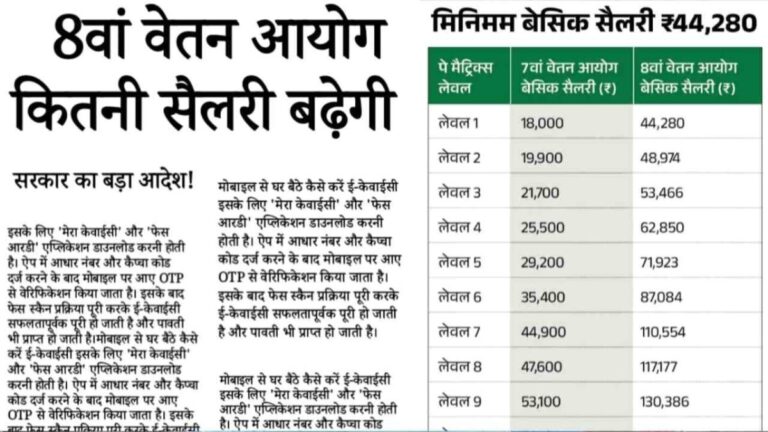
8th Pay Commission Salary: सरकार ने लोकसभा में दी बड़ी जानकारी, कर्मचारियों और पेंशनर्स के लिए खुशखबरी

8th Pay Commission Salary: The government has given important information in the Lok Sabha, bringing good news for employees and pensioners.

A major relief has emerged for the country’s more than 50 lakh central government employees and approximately 69 lakh pensioners. The central government has clearly stated in the Lok Sabha that the 8th Pay Commission has been formed and its Terms of Reference (ToR) notification was issued on November 3, 2025. Now all eyes are focused on when the new salary and pension rules will actually be implemented.

8th Pay Commission: Notification and Scope

Union Minister of State for Finance Pankaj Chaudhary provided this information in a written response to the Lok Sabha. The government has made several key announcements regarding the commission’s formation and functioning.

The official confirmation brings much-needed clarity to millions of government employees who have been eagerly awaiting updates about their salary revisions.

  • Formation Confirmation: The government has stated that the 8th Pay Commission has already been constituted and its Terms of Reference were notified on November 3, 2025.
  • Commission’s Work: This commission’s responsibility will be to review the structure related to salary, allowances, and pension for central employees, defense personnel, All India Services, and Union Territory employees.
  • Chairman and Members: Retired Justice Ranjan Prakash Desai is heading this commission. Professor Pulak Ghosh has been appointed as part-time member and Pankaj Jain as member secretary. The commission’s headquarters has been established in Delhi.

Who Will Be the Beneficiaries?

According to the government’s response, this commission’s scope will include a total of 50.14 lakh central government employees and approximately 69 lakh pensioners. The following institutions are also included:

  • Central government departments
  • All India Services
  • Defense forces
  • Union Territory employees
  • Judiciary and Parliament-affiliated institutions

This comprehensive coverage ensures that virtually all central government employees across different sectors will benefit from the commission’s recommendations.

When Will New Salary Be Implemented?

The government has also provided information about the timeline for submitting the commission’s report and its implementation. However, the exact implementation date remains uncertain.

According to the official response, the commission will submit its report within 18 months from the date of formation. The central government has clarified that decisions regarding implementation date and funding will only be made after receiving the commission’s recommendations.

Additionally, there is a possibility that the commission may submit interim reports on certain subjects, which could allow some recommendations to be implemented earlier than others.

Currently, the government has made it clear that the implementation date has not yet been decided and will only be announced after the recommendations are received.

Expected Timeline and Process

The commission’s working methodology follows a structured approach that includes comprehensive analysis of current pay structures, inflation factors, and economic conditions. The 18-month timeline indicates that the commission will conduct thorough research before making its recommendations.

Furthermore, the commission has been given broad powers to ensure that it can prepare its report according to modern economic requirements and current market conditions.

Future Path and Expectations

There is both excitement and hope among employees regarding this commission. The last time, the 7th Pay Commission brought significant improvement in employee salaries and benefits.

The government’s approach is being considered positive because this time the commission has been given comprehensive powers to prepare its report according to modern economic needs. This suggests that the recommendations may be more aligned with current economic realities and employee expectations.

Moreover, the inclusion of defense personnel and All India Services in the commission’s scope demonstrates the government’s commitment to addressing salary issues across all central government sectors comprehensively.

The formation of the 8th Pay Commission represents a significant step toward ensuring fair compensation for central government employees and pensioners, keeping pace with inflation and economic growth in the country.

Frequently Asked Questions

When was the 8th Pay Commission formed and notified?

The 8th Pay Commission has been formed and its Terms of Reference were officially notified on November 3, 2025, as confirmed by the government in Lok Sabha.

How many employees and pensioners will benefit from the 8th Pay Commission?

According to government data, approximately 50.14 lakh central government employees and around 69 lakh pensioners will benefit from the 8th Pay Commission recommendations.

Who is heading the 8th Pay Commission?

Retired Justice Ranjan Prakash Desai is chairing the 8th Pay Commission, with Professor Pulak Ghosh as part-time member and Pankaj Jain as member secretary.

When will the 8th Pay Commission submit its report?

The commission will submit its report within 18 months from the date of formation. However, interim reports on specific subjects may be submitted earlier.

When will the new salary structure be implemented?

The implementation date has not been decided yet. The government will announce the implementation timeline and funding arrangements only after receiving the commission’s recommendations.

8th Pay Commission New Update : सभी कर्मचारियों के लिए हुई बल्ले बल्ले सुप्रीम कोर्ट के द्वारा आठवीं वेतन बढ़ोतरी में क्या-क्या लाभ मिलेगा जाने ?

The 8th Pay Commission brings exciting news for all government employees across India. Starting January 2026, the Indian government will implement comprehensive salary reforms that promise significant financial relief amid rising inflation costs.

Government employees nationwide are celebrating as the Supreme Court has approved substantial benefits under the eighth pay commission. This landmark decision addresses the growing economic challenges faced by public sector workers.

Implementation Timeline and Key Announcements

The Indian government has completed preparations for implementing the 8th Pay Commission starting January 2026. This initiative specifically targets providing financial assistance to government employees struggling with increased living costs.

Moreover, the government has issued official directives following the commission’s approval. All eligible employees will receive enhanced benefits designed to counter inflation pressures.

The All India Railwaymen Federation (AIRF) General Secretary recently shared crucial information regarding the commission’s report and pending payment schedules. This provides clearer insight into the implementation timeline.

Report Preparation and Expected Implementation Schedule

The commission is currently finalizing comprehensive reports that will guide the new salary structure. Furthermore, detailed guidelines are being prepared to ensure smooth implementation across all government departments.

However, the preparation process requires extensive research and analysis. Therefore, the complete rollout may take several months beyond the initial launch date.

Arrears Payment: Extended Waiting Period (2029)

The most concerning aspect for employees involves the arrears payment schedule. According to AIRF General Secretary’s recent statements, employees may need to wait longer than expected.

The anticipated arrears payment date falls around 2029. Additionally, political strategy considerations suggest the government may time this major payment around the 2029 Lok Sabha elections.

This extended waiting period may disappoint many employees. Consequently, unions continue pressuring the government to expedite report preparation and ensure quicker arrears distribution.

Major Changes in Salary Structure

The 8th Pay Commission extends beyond simple salary increases. Instead, it represents a complete restructuring of the government compensation framework.

Comparative Analysis and Market Alignment

The commission will conduct thorough studies comparing private sector, public sector undertaking (PSU), and state government salary structures. This ensures government employee compensation remains competitive and equitable across sectors.

Additionally, the analysis will identify gaps in current compensation packages. Therefore, recommendations will address market-driven salary adjustments.

Allowance Restructuring and Enhancement

Considering inflation impacts, all allowances will undergo comprehensive review and adjustment:

  • Gratuity benefits will see substantial increases
  • Bonus structures will be enhanced significantly
  • House Rent Allowance (HRA) rates will be revised upward
  • Travel allowances will receive adequate adjustments

These changes aim to maintain employees’ purchasing power amid rising costs. Furthermore, the enhanced allowance structure will provide better financial security.

Pension Benefits and Minimum Pension Increases

The commission prioritizes reducing disparities between old and new pension recipients. This ensures all pensioners receive fair treatment regardless of their retirement date.

Particularly exciting news awaits all employees as pension increases are confirmed. The fitness factor enhancement will substantially boost pension amounts for over 6.5 million employees and retirees.

Moreover, minimum pension rates will see significant improvements. Therefore, even the lowest pension brackets will provide better financial support to retirees.

Expected Benefits for Government Employees

The 8th Pay Commission promises comprehensive improvements across multiple areas:

  • Base salary increases ranging from 15-20% across different grades
  • Enhanced dearness allowance calculations
  • Improved medical benefits and healthcare coverage
  • Better retirement planning options
  • Modernized leave and travel policies

Additionally, the commission addresses long-standing employee grievances. Therefore, the new structure will provide more balanced work-life benefits.

Conclusion

The 8th Pay Commission represents a significant milestone for Indian government employees. While the implementation timeline extends into 2026 and arrears may take until 2029, the promised benefits offer substantial financial relief.

The comprehensive salary restructuring, enhanced allowances, and improved pension benefits demonstrate the government’s commitment to employee welfare. However, patience will be required as the complex implementation process unfolds over the coming years.

Frequently Asked Questions

When will the 8th Pay Commission be implemented?

The 8th Pay Commission implementation is scheduled to begin in January 2026. However, the complete rollout across all departments may take several additional months.

How long will employees wait for arrears payment?

According to AIRF officials, arrears payments may not be distributed until around 2029. The government may time these payments strategically around the 2029 Lok Sabha elections.

What salary increase percentage can employees expect?

While official percentages haven’t been announced, employees can anticipate salary increases ranging from 15-20% across different grade levels, along with enhanced allowances and benefits.

Will pensioners benefit from the 8th Pay Commission?

Yes, over 6.5 million pensioners will receive increased pension amounts through fitness factor enhancements. The commission also aims to reduce disparities between old and new pension recipients.

Which allowances will be revised under the new commission?

All major allowances including gratuity, bonus, HRA, travel allowance, and dearness allowance will undergo comprehensive review and enhancement to match current inflation levels.