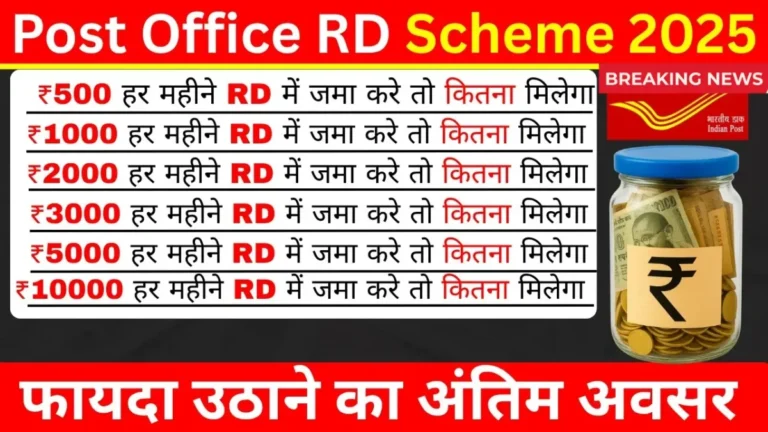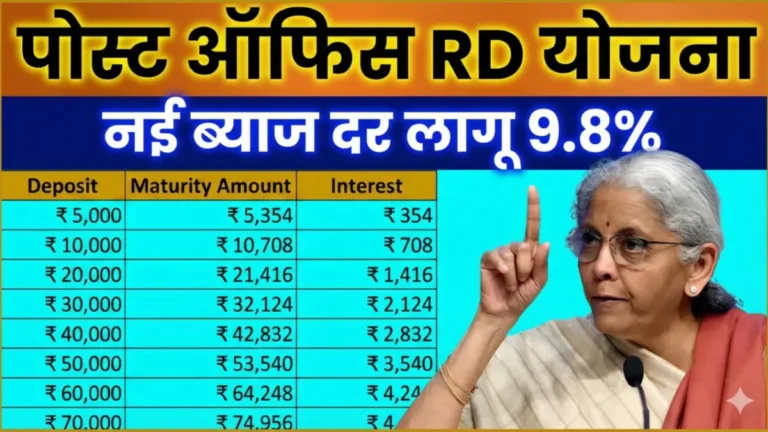
₹13 हजार रुपये जमा करने पर 5 साल बाद मिलेंगे ₹9,27,753 रुपये का रिटर्न Post Office RD Yojana

By depositing ₹13,000, you will receive a return of ₹9,27,753 after 5 years under the Post Office RD Scheme.

Post Office RD Yojana offers a secure monthly savings option where depositing ₹13,000 monthly can yield ₹9,27,753 after 5 years. This government-backed scheme provides guaranteed returns without market risks, making it ideal for salaried individuals and small business owners seeking steady wealth creation. The scheme operates on a 6.7% annual interest rate with quarterly compounding, ensuring your money grows consistently over time.

How Post Office RD Scheme Works

The Post Office Recurring Deposit runs for 5 years or 60 months. Currently, the scheme offers approximately 6.7% annual interest, compounded quarterly. This means each monthly installment earns interest for different durations.

Money deposited earlier earns interest for a longer period, while later deposits accumulate interest for shorter durations. However, all installments combine to create a substantial fund after 5 years. Since this is a completely government scheme, your deposited money remains entirely secure.

Total Investment with ₹13,000 Monthly Deposits

When you deposit ₹13,000 monthly in Post Office RD, your total investment over 5 years becomes ₹7,80,000. This represents the actual amount you save from your pocket gradually over time.

The real benefit begins when quarterly compound interest gets added to this amount, making your fund grow rapidly. Therefore, the power of compounding transforms your regular savings into substantial wealth.

How ₹9,27,753 Maturity Amount is Calculated

Now comes the calculation every investor wants to understand. With a 6.7% annual interest rate, running an RD of ₹13,000 for 60 months yields approximately ₹9,27,753 at maturity.

Your total deposited amount equals ₹7.8 lakh, but compound interest adds approximately ₹1,47,753 as additional earnings. This entire benefit comes from compounding, making RD a powerful method for transforming small savings into large funds.

Furthermore, the quarterly compounding ensures that interest earned also starts earning interest, maximizing your returns over the investment period.

Who Should Consider ₹13,000 RD Investment

This investment suits people with stable income who can comfortably set aside a fixed amount monthly. Salaried employees, small business owners, and families preparing for future major expenses find this plan extremely useful.

Moreover, it involves no significant risk or complexity. You simply deposit a fixed amount monthly, and the fund grows automatically over time. Additionally, the government backing provides complete security for your investment.

Practical Uses for ₹9.28 Lakh Fund After 5 Years

The approximately ₹9.28 lakh fund received after 5 years can serve multiple purposes:

  • Children’s education expenses
  • Home renovation projects
  • Down payment for new vehicle
  • Business expansion capital
  • Emergency financial requirements

Many investors reinvest this amount in other secure schemes to further grow their wealth. However, Post Office RD’s main advantage is preparing you for the future without any risk.

Impact of Premature RD Closure

If circumstances force you to close the RD before maturity, Post Office allows this facility. Nevertheless, premature closure may result in slightly reduced interest rates.

Therefore, it’s better to let the RD run for the complete 5 years. This ensures you receive the full benefit of compound interest and your fund reaches its maximum potential.

Key Benefits of Post Office RD Scheme

The scheme offers several advantages that make it attractive for conservative investors:

  • Government guarantee ensures complete safety
  • Quarterly compounding maximizes returns
  • Flexible monthly installments
  • Tax benefits under certain conditions
  • No market-related risks

Additionally, the scheme helps develop disciplined saving habits while building substantial wealth over time.

Frequently Asked Questions

What is the current interest rate for Post Office RD?

Post Office RD currently offers approximately 6.7% annual interest rate, compounded quarterly. However, interest rates may change periodically based on government policies.

Can I deposit more than ₹13,000 monthly in Post Office RD?

Yes, Post Office RD allows flexible monthly deposits. You can choose any amount that suits your budget and financial goals.

Is Post Office RD better than bank RD schemes?

Post Office RD typically offers competitive interest rates compared to banks, plus government backing provides additional security. However, compare current rates before deciding.

What happens if I miss a monthly installment?

Post Office provides some flexibility for missed installments with minimal penalty charges. However, regular deposits ensure maximum benefit from compounding.

Can I open multiple RD accounts in Post Office?

Yes, you can open multiple RD accounts with different amounts and tenures based on your investment strategy and financial planning needs.

Disclaimer: This article is written for general information purposes only. Post Office RD interest rates may change from time to time. Please check the latest interest rates and rules from your nearest post office before investing. This is not financial advice of any kind.

पीएम किसान योजना की 22वीं किस्त कब आएगी? जानें फाइनल डेट और अपडेट Pm Kisan 22th installment Date 2025

PM Kisan 22nd installment, PM Kisan installment date 2025, PM Kisan Yojana update, PM Kisan payment status, PM Kisan beneficiary list, Kisan scheme 2025, farmer scheme update, PM Kisan news today, PM Kisan release date,

The Pradhan Mantri Kisan Samman Nidhi Yojana (PM-Kisan Yojana) serves as a crucial government scheme for crores of farmers across the nation. Under this initiative, the central government provides 6,000 rupees annual financial assistance to farmers. This amount is transferred directly into farmers’ bank accounts through Direct Benefit Transfer (DBT) in three equal installments of 2,000 rupees each.

This scheme helps farmers meet small farming-related expenses, thereby strengthening their economic condition. Farmers have already received 21 installments under this scheme. Now, everyone eagerly awaits the 22nd installment.

There is ongoing discussion among farmers regarding when this installment will arrive. However, the government has not yet announced any official date. Nevertheless, based on previous installment patterns and government sources, some probable dates are emerging. This article provides you with the final date for the 22nd installment and all latest updates related to it.

When Will PM Kisan Yojana’s 22nd Installment Arrive? Know the Probable Timeline

Under the PM Kisan Samman Nidhi Yojana, installments are released every four months. This scheme makes three installment payments throughout the year, with the scheduled timing as follows:

  • First installment: Between April to July
  • Second installment: Between August to November
  • Third installment: Between December to March

Recently, the 21st installment of the scheme was released on November 19, 2025. The next installment is likely to arrive four months after this release.

The 21st installment arrived in November 2025. Therefore, according to regulations, the next or 22nd installment may arrive between January 2026 to March 2026. According to media reports and Agriculture Ministry sources, there is the highest probability of this installment being released in February 2026. However, farmers should note that this is a probable timeframe, and no date can be considered final until an official announcement is made.

Essential Tasks and Latest Updates for Receiving the 22nd Installment

To benefit from the 22nd installment, farmers must ensure that their accounts have no errors. The government has tightened some rules to eliminate fake farmers and bring transparency to the scheme.

If you haven’t completed these essential tasks, your 22nd installment might get stuck.

1. e-KYC (Electronic Know Your Customer)

Completing e-KYC is mandatory for all beneficiaries. If your e-KYC is not completed, you will not receive the 22nd installment payment.

You can complete this immediately by visiting the PM Kisan official website (pmkisan.gov.in) or by going to your nearest Common Service Center (CSC).

2. Aadhaar Seeding and DBT Activation

Your bank account must be linked with your Aadhaar card (Aadhaar seeding). Additionally, DBT (Direct Benefit Transfer) must be activated in your bank account.

If your account is not linked with Aadhaar, the installment money will not be credited to your account. Visit your bank branch and complete this task as soon as possible.

3. Land Records Verification

Your land documents (land records) verification must be completed by the state government’s agriculture department. Farmers whose land seeding is still showing “No” need to contact the agriculture department to make it “Yes”.

The government is re-verifying farmers whose records have shown problems.

4. Beneficiary Status Check

Before the installment arrives, you should definitely check your Beneficiary Status on the official portal.

  • Visit pmkisan.gov.in
  • Click on ‘Know Your Status’ in ‘Farmer’s Corner’
  • Enter your registration number
  • Here you can see information about your eligibility, e-KYC, land seeding, and bank status

If the status shows “Yes” next to ‘Aadhaar Status’ and ‘Land Seeding’, then you will face no difficulty in receiving the installment.

Pradhan Mantri Kisan Samman Nidhi Yojana: An Overview

Scheme Name: Pradhan Mantri Kisan Samman Nidhi Yojana (PM-Kisan)

Launch: February 24, 2019 (effective from December 2018)

Objective: Provide financial assistance to farmers

Beneficiaries: Eligible farmer families with cultivable land

Annual Amount: 6,000 rupees

Installment Amount: 2,000 rupees per installment

Total Installments: 3 installments (every four months)

Payment Method: Direct Benefit Transfer (DBT)

Official Website: pmkisan.gov.in

PM Kisan Scheme’s Importance and Government’s Strictness Against Fraud

The PM Kisan scheme serves as major support for the country’s farmers. It provides financial help to small and marginal farmers for purchasing fertilizers, seeds, and other essential farming materials. This money proves particularly useful for farmers before Rabi and Kharif season sowing.

Before releasing the 22nd installment, the government is taking strict action against fake beneficiaries. Crores of people across the country have been found who were ineligible for this scheme but were wrongly receiving benefits. The government is recovering money from such people and removing their names from the beneficiary list.

Due to this strictness, only eligible farmers will be able to benefit from the installment. Therefore, all farmers should ensure that all their documents and records are completely correct and updated.

Final Suggestions and Conclusion

The probable date for PM Kisan scheme’s 22nd installment is February 2026. However, all farmers are advised to regularly check the PM Kisan website for any government and official announcements.

To avoid any hindrance in the installment, immediately complete all essential tasks like e-KYC, Aadhaar-bank linking, and land record verification. This financial assistance represents a significant step toward increasing farmers’ income and making them self-reliant.

Frequently Asked Questions

When will PM Kisan 22nd installment be released in 2026?

Based on previous patterns and government sources, the 22nd installment is likely to be released in February 2026. However, farmers should wait for official confirmation from the government.

What documents are required for PM Kisan 22nd installment?

You need completed e-KYC, Aadhaar-linked bank account, verified land records, and active DBT status. All these requirements must be fulfilled to receive the installment.

How can I check my PM Kisan beneficiary status?

Visit pmkisan.gov.in, go to ‘Farmer’s Corner’, click ‘Know Your Status’, and enter your registration number. This will show your eligibility, e-KYC, and land seeding status.

What is the amount of PM Kisan installments?

Each PM Kisan installment is 2,000 rupees, paid three times a year, totaling 6,000 rupees annually. The money is transferred directly to farmers’ bank accounts through DBT.

Why might my PM Kisan installment get stuck?

Your installment might get stuck due to incomplete e-KYC, unlinked Aadhaar with bank account, unverified land records, or inactive DBT status. Complete all these requirements to receive your installment.

फ्री राशन के साथ हर महीने मिलेंगे ₹1000 रुपये, सरकार ने की घोषणा Free Ration Yojana

Along with free rations, ₹1000 will be given every month; the government has made this announcement under the Free Ration Yojana.

The central government has announced a significant enhancement to the Free Ration Yojana 2025, introducing monthly cash assistance of ₹1000 alongside free ration distribution. This groundbreaking decision aims to provide comprehensive support to millions of needy families struggling with rising inflation and food costs across the country.

Rising Inflation Challenges for Common Families

The escalating prices of essential commodities have made daily life increasingly difficult for poor and middle-class families. Grains, pulses, oil, and other necessary food items continue to become more expensive, directly impacting household budgets.

Moreover, this economic pressure has particularly affected daily wage earners, small farmers, and families with unstable incomes. Therefore, the government has taken this crucial step to provide immediate relief through enhanced benefits.

Free Ration Yojana 2025 Objectives

The Free Ration Yojana 2025 serves multiple purposes beyond just food distribution. The scheme aims to ensure food security while providing economic stability to vulnerable families.

Additionally, the program focuses on eliminating hunger and ensuring that basic nutritional needs are met. The dual benefit of free ration plus cash assistance creates a comprehensive support system for beneficiaries.

Extension of Pradhan Mantri Garib Kalyan Anna Yojana

This enhanced scheme operates as an extension of the existing Pradhan Mantri Garib Kalyan Anna Yojana. Under this program, eligible families receive five kilograms of free ration per person every month.

Furthermore, the distribution occurs through Public Distribution System (PDS) shops across the nation. This ensures systematic and organized delivery of food grains to poor families nationwide.

₹1000 Monthly Cash Assistance Benefits

The government has introduced an additional ₹1000 cash assistance for each eligible family alongside the free ration provision. This amount transfers directly to beneficiary bank accounts through Direct Benefit Transfer (DBT) system.

However, this direct transfer mechanism eliminates middlemen involvement and ensures complete amounts reach intended recipients. The cash assistance provides families flexibility to purchase other essential items beyond food grains.

Special Relief During Festivals

The government recognizes increased expenditure during festival seasons. Families require additional funds for clothing, sweets, worship materials, and other ceremonial necessities.

Therefore, the ₹1000 monthly assistance proves particularly beneficial during festive occasions, enabling poor families to celebrate festivals with dignity and joy.

Strengthening Food Security and Economic Stability

The Free Ration Yojana 2025 primarily ensures no poor family in the country remains hungry. According to constitutional provisions, the right to food represents a fundamental right, and this scheme strengthens that commitment.

Additionally, the ₹1000 assistance helps families cover medical expenses, children’s education costs, and other essential household expenditures. This comprehensive approach addresses multiple aspects of poverty alleviation.

Eligibility Criteria and Requirements

Only families possessing ration cards issued under the National Food Security Act qualify for this scheme. Antyodaya Anna Yojana cardholders also fall within the eligible category.

Furthermore, the government has established clear eligibility rules to ensure benefits reach genuinely needy families. Family annual income must remain below prescribed limits as per government guidelines.

Essential Conditions for Eligibility

  • Family annual income below specified threshold
  • Name inclusion in government eligibility list
  • Bank account linked with Aadhaar and ration card
  • Valid mobile number for communication

Required Documents and Verification Process

Beneficiaries must provide specific documents for scheme enrollment and verification. These include Aadhaar card, ration card, bank passbook, active mobile number, and recent photographs.

Moreover, thorough document verification ensures only eligible candidates receive benefits. This systematic approach prevents fraudulent claims and maintains scheme integrity.

Online Application and Verification Process

The government has simplified the application and verification process through online facilities. Beneficiaries can visit their state’s Food and Civil Supplies Department website to check eligibility using ration card numbers.

Additionally, eligible candidates automatically receive free ration and ₹1000 cash assistance without visiting government offices. This digital approach saves time and reduces bureaucratic hassles for common people.

Therefore, this enhanced Free Ration Yojana represents a significant step toward comprehensive poverty alleviation and food security in India.

Frequently Asked Questions

Who is eligible for Free Ration Yojana 2025 with ₹1000 cash assistance?

Families holding ration cards under National Food Security Act and Antyodaya Anna Yojana are eligible. Additionally, family income must be below prescribed limits and bank accounts must be linked with Aadhaar.

How will the ₹1000 monthly assistance be transferred?

The cash assistance transfers directly to beneficiary bank accounts through Direct Benefit Transfer (DBT) system. This eliminates middlemen and ensures complete amounts reach intended recipients without delays.

What documents are required for scheme enrollment?

Required documents include Aadhaar card, valid ration card, bank passbook, active mobile number, and recent photographs. All documents must be properly verified before benefit distribution begins.

How can I check my eligibility status online?

Visit your state’s Food and Civil Supplies Department website and enter your ration card number to verify eligibility. The online system provides immediate status updates and eliminates office visits.

How much free ration will families receive monthly?

Eligible families receive five kilograms of free ration per person every month through Public Distribution System shops. This quantity ensures basic food security for all family members throughout the month.

₹12 हजार रुपये जमा करने पर 5 साल बाद मिलेंगे ₹8,56,388 रुपये का रिटर्न Post Office RD Scheme

The Post Office RD Scheme stands out as one of the safest and most accessible investment options for individuals looking to build a substantial fund through monthly savings. Many investors wonder about the potential returns when depositing ₹12,000 monthly in a Post Office Recurring Deposit for five years. With the current interest rate structure, this investment strategy yields impressive results, offering a maturity amount of approximately ₹8,56,388 against a total investment of ₹7,20,000.

How Does Post Office RD Work?

The Post Office Recurring Deposit operates on a five-year tenure with a current annual interest rate of 6.7%. This interest compounds quarterly, maximizing your returns over time.

Each monthly installment earns interest based on its deposit duration. Therefore, earlier deposits accumulate interest for the full five years, while later deposits earn proportionally less interest until maturity. This compounding mechanism transforms regular monthly contributions into a substantial corpus.

Complete Calculation of ₹12,000 Monthly RD for 5 Years

When you deposit ₹12,000 monthly in a Post Office RD, your total principal investment over 60 months amounts to ₹7,20,000. However, with the 6.7% annual compounding interest, the maturity value reaches approximately ₹8,56,388.

This means you earn approximately ₹1,36,388 as interest over the five-year period. The power of compounding transforms this seemingly modest monthly saving into a significant fund that grows exponentially over time.

Who Should Consider ₹12,000 Monthly RD Investment?

This investment amount suits individuals with stable income streams who want to develop disciplined saving habits. Furthermore, it’s ideal for salaried professionals, small business owners, or anyone preparing for future major expenses.

Additionally, risk-averse investors who prefer guaranteed returns over market volatility find Post Office RD particularly attractive. The scheme offers peace of mind with principal protection and assured interest rates.

Why Do People Prefer RD’s Safety Features?

Post Office operates under complete government guarantee, ensuring absolute security of your invested capital. Moreover, the fixed interest rate provides predictability, allowing you to calculate exact maturity proceeds in advance.

This reliability factor makes the scheme appealing to millions of investors who prioritize capital preservation over higher but uncertain returns. Consequently, families can plan their financial future with confidence.

Can You Close RD Before Maturity?

Yes, you can close your RD before the five-year maturity period if needed. However, premature closure results in reduced interest rates, typically aligned with savings account rates.

Therefore, it’s advisable to maintain the RD for the complete tenure to maximize compounding benefits. This approach ensures you receive the full advantage of the higher interest rate structure.

How Can This Fund Be Utilized After 5 Years?

The ₹8.56 lakh corpus becomes extremely versatile for various financial needs. Investors commonly use this amount for home renovations, children’s education fees, vehicle down payments, or small business ventures.

Additionally, this risk-free accumulated wealth provides financial security and flexibility for unexpected expenses or planned major purchases. The substantial amount creates multiple opportunities for wealth deployment.

Tax Benefits and Considerations

Post Office RD offers certain tax advantages under Section 80C of the Income Tax Act. However, the interest earned is taxable as per your income tax slab.

Nevertheless, the guaranteed returns and government backing often outweigh the tax implications for conservative investors. Therefore, consult with tax advisors for optimal tax planning strategies.

Frequently Asked Questions

What is the minimum amount required to start a Post Office RD?

The minimum monthly deposit for Post Office RD is ₹100, while there’s no maximum limit. You can choose any amount based on your financial capacity and investment goals.

Can I increase my monthly RD amount mid-term?

No, you cannot increase the monthly deposit amount in an existing RD account. However, you can open multiple RD accounts with different monthly amounts if needed.

What happens if I miss a monthly RD payment?

Missing payments attracts a penalty fee, and your account may become irregular. It’s important to maintain timely payments to avoid complications and ensure smooth maturity.

Is Post Office RD better than bank RD schemes?

Post Office RD typically offers slightly higher interest rates compared to most bank RDs. Additionally, government backing provides superior security compared to private sector alternatives.

Can NRIs invest in Post Office RD schemes?

No, Non-Resident Indians (NRIs) are not eligible to invest in Post Office RD schemes. These schemes are exclusively available for Indian residents only.

Disclaimer: This article is written for general information purposes only. Interest rates may change over time, so please check the latest interest rates and terms with your nearest post office before investing. This does not constitute financial advice.

2025 Senior Scheme Update: 8 Major Benefits for Citizens Aged 65+ and 70+ With New Support, Better Coverage & Added Security

2025 Senior Scheme Update: 8 Major Benefits for Citizens Aged 65+ and 70+ With New Support, Better Coverage & Added Security

The 2025 Senior Citizens Scheme update brings transformative changes for elderly citizens across India, delivering enhanced financial support, improved healthcare systems, and robust social security frameworks. These comprehensive modifications aim to reduce the financial burden on senior citizens while enabling them to maintain a dignified and independent lifestyle.

Furthermore, these restructured programs serve a diverse range of individuals aged 65 and above. The modifications represent crucial advancement toward ensuring a brighter future for pensioners nationwide.

Strengthening the Pension System

The enhancement of monthly pension payments for elderly citizens guarantees a steady and dependable income source. This financial support assists seniors with essential expenses including medicines, groceries, and utility payments during times of increasing inflation.

Moreover, the government aims to make senior citizens financially more independent while reducing their dependence on family members. This approach promotes greater autonomy and self-reliance among the elderly population.

Expanded Healthcare Support

Healthcare coverage remains a primary concern for senior citizens, which is why medical support has been significantly enhanced in 2025. Additional assistance will be offered for hospital stays, serious medical conditions, and essential healthcare services.

Additionally, this expansion guarantees that elderly citizens have convenient and affordable access to quality healthcare. The improved coverage addresses critical gaps in medical support for aging populations.

Complimentary Senior Health Screenings

Free annual health examinations are now accessible for individuals aged 65+ and 70+. These comprehensive evaluations include screenings for diabetes, cardiovascular conditions, hypertension, and other age-related health concerns.

Therefore, these screenings enable early detection of health issues, thereby preventing significant medical expenses. Early intervention often leads to better health outcomes and reduced long-term healthcare costs.

Enhanced Interest Rates for Senior Savers

The government has launched special investment programs and better interest rates specifically for elderly citizens. These schemes offer more favorable terms than standard accounts, providing retirement savings with safe and faster growth opportunities.

This higher interest serves as an additional benefit through which seniors can boost their monthly income. The enhanced rates help combat inflation and preserve purchasing power for fixed-income seniors.

Transportation Fare Reductions

During 2025, elderly citizens will receive enhanced discounts on public transportation including buses, metro systems, and railway services. This initiative makes travel affordable and accessible for senior citizens across the country.

However, this important benefit allows senior citizens to travel comfortably, maintain social connections, and easily reach medical appointments and other essential destinations as needed.

Preferential Service Access

Elderly citizens now receive priority treatment at all government offices, banks, and medical facilities. Special queues and faster processing significantly improve service efficiency for senior citizens.

Furthermore, this system provides convenience for senior citizens while preserving their respect and dignity. The priority access reduces waiting times and physical strain on elderly individuals.

Protection and Emergency Support

The government has introduced various new programs focused on the safety of senior citizens living alone. These include helpline services, community support programs, rapid emergency response systems, and other assistance services.

Additionally, these measures ensure access to immediate assistance during emergency situations while providing peace of mind to senior citizens and their families. The comprehensive support network addresses safety concerns effectively.

Economic Aid and Cost Relief Programs

Electricity bills, essential commodities, home maintenance, and medical equipment now receive expanded subsidies. This significantly reduces senior citizens’ daily expenses and improves their overall quality of life.

Therefore, this financial assistance proves crucial for maintaining an enhanced quality of life for elderly individuals affordably. The cost relief programs address multiple areas of daily living expenses.

The 2025 Senior Citizens Scheme update delivers substantial improvements in financial stability, healthcare services, safety, and various other systems affecting senior citizens’ daily lives. Eligible citizens aged 65 years and above, along with those who are 70 years or older, should submit applications promptly to access these benefits. The government’s primary objective focuses on ensuring that every senior citizen enjoys a secure, dignified, and stress-free life.

Frequently Asked Questions

Who qualifies for the 2025 Senior Citizens Scheme benefits?

Citizens who are 65 years old and above, along with individuals aged 70 years and older, qualify for these improved benefits and assistance programs. Eligible applicants must meet age requirements and submit proper documentation.

What healthcare benefits are included in the 2025 update?

The update features expanded medical coverage for hospital care and serious illnesses, complimentary annual health screenings including diabetes and heart disease tests, plus subsidies for medical equipment. Free preventive care services are also available.

How do the pension system improvements help senior citizens?

The strengthened monthly pension provides a steady and dependable income source, assisting seniors with purchasing medications, food, and paying bills. This enhancement reduces financial dependence on family members significantly.

What transportation discounts are available for seniors?

Senior citizens receive enhanced discounts on public transportation including buses, metro systems, and trains. These reduced fares make travel affordable and help seniors maintain social connections and access essential services.

How can senior citizens apply for these benefits?

Eligible seniors can apply through government offices, online portals, or designated application centers. Required documents typically include age proof, identity verification, and income certificates for processing applications efficiently.

₹60 हजार सालाना जमा करने पर मिलेंगे ₹16,27,000 रुपये का रिटर्न Post Office PPF Scheme

By investing ₹60,000 annually, you can get a return of ₹16,27,000 through the Post Office PPF Scheme.

Every parent dreams of building a secure financial foundation for their children’s future. The Post Office PPF Scheme emerges as one of the most trusted investment options, offering complete safety, attractive interest rates, and tax-free maturity benefits. When you invest ₹60,000 annually in this scheme, the remarkable power of compound interest transforms your investment into a substantial corpus of ₹16,27,000 over 15 years.

Understanding how this calculation works is crucial before starting your investment journey. Moreover, this government-backed scheme provides unmatched security while building wealth for your family’s long-term goals.

Current PPF Interest Rate and Key Features

The PPF scheme currently offers a 7.1% annual interest rate, which the government reviews quarterly. This 15-year investment plan allows contributions between ₹500 to ₹1.5 lakh annually.

The scheme’s biggest advantage lies in its compound interest mechanism. Each year, the interest earned gets added to the principal amount, accelerating wealth creation significantly. Furthermore, the government backing ensures zero risk to your invested capital.

Three key benefits make PPF an ideal choice: tax exemption on investment, stable returns, and complete government security. These features combined create a powerful wealth-building tool for every family.

Total Investment with ₹60,000 Annual Contribution

When you invest ₹60,000 every year for 15 years, your total contribution amounts to ₹9,00,000. This represents the actual money you put into the scheme from your pocket.

However, the real magic happens when compound interest starts working on this amount. The interest earned each year gets reinvested automatically, creating a snowball effect that dramatically increases your final corpus.

How ₹16,27,000 Maturity Fund Gets Created

The most exciting part is understanding how your ₹9 lakh investment grows to ₹16,27,000 at maturity. With a 7.1% interest rate compounding annually, your money nearly doubles over the 15-year period.

This means you earn approximately ₹7,27,000 as interest on your original investment. The power of compound interest becomes most evident in long-term investments like PPF, where time works as your greatest ally.

Most importantly, this entire maturity amount comes to you completely tax-free. Therefore, you receive every single rupee without any deductions or tax implications.

Supporting Children’s Future Financial Needs

Today’s educational expenses, career development costs, professional courses, and life events require substantial financial planning. A corpus of over ₹16 lakh provides significant financial security for your family’s major goals.

This amount serves as an excellent foundation for higher education, business ventures, or other significant life investments. Additionally, many parents choose to reinvest this maturity amount into other secure schemes for continued wealth growth.

The timing of PPF maturity often aligns perfectly with children reaching college age or career-starting phase, making it an ideal planning tool.

Why PPF Stands Out for Children’s Future Planning

PPF enjoys complete government backing, ensuring absolute safety of your invested capital. The scheme falls under the EEE tax category, providing triple tax benefits: exemption on investment, tax-free interest, and tax-free maturity proceeds.

No other safe investment option provides such comprehensive tax advantages combined with government security. The long-term nature perfectly matches children’s future needs, allowing sufficient time for wealth accumulation.

Consistent returns through compound interest make financial planning predictable and reliable. These factors collectively position PPF as one of the strongest options for securing children’s future financial requirements.

Strategic Tips for Maximizing PPF Benefits

Start your PPF investment as early as possible to maximize the compound interest advantage. Consider opening separate accounts for each child to multiply the investment limit and benefits.

Make annual contributions in early April to earn interest for the complete financial year. This simple timing strategy can add thousands of rupees to your final corpus over 15 years.

Plan your contributions systematically to avoid missing any year, as gaps can significantly impact your final returns due to lost compounding opportunities.

Frequently Asked Questions

Can I invest more than ₹60,000 annually in PPF?

Yes, you can invest up to ₹1.5 lakh per financial year in PPF. Higher contributions will proportionally increase your maturity corpus and interest earnings.

What happens if PPF interest rates change during the investment period?

PPF interest rates are reviewed quarterly by the government. Any changes will affect future interest calculations, but your existing corpus remains protected with previously earned interest.

Can I withdraw money from PPF before 15 years?

Partial withdrawals are allowed after the 7th year for specific purposes like education or medical emergencies. However, premature closure is generally not permitted, ensuring long-term wealth building.

Is there any tax on PPF interest earnings?

No, PPF offers complete tax exemption under EEE category. Your contributions, interest earnings, and maturity amount are all entirely tax-free, maximizing your effective returns.

How does PPF compare with other investment options for children?

PPF combines government security, tax benefits, and steady returns better than most alternatives. While equity investments might offer higher returns, PPF provides guaranteed safety with respectable growth for conservative investors.

Disclaimer: This article provides general information only. PPF interest rates may change periodically. Please verify current rates and terms with your post office or bank before investing. This content does not constitute financial advice.

₹60 हजार सालाना जमा करने पर मिलेंगे ₹16,27,000 रुपये का रिटर्न Post Office PPF Scheme

By investing ₹60,000 annually, you can get a return of ₹16,27,000 through the Post Office PPF Scheme.

Every parent wants to create a secure and strong fund for their children that can be used without worry for future education, career, or any major financial need. Post Office PPF Scheme stands as the most trusted investment option during such times because it keeps money completely safe, offers good interest rates, and provides the entire fund tax-free at maturity. If someone deposits ₹60,000 annually in this scheme, understanding how much fund will be ready after 15 years and the interest earned becomes crucial before starting the investment to get a clear financial picture.

Current Interest Rate in PPF Scheme

PPF currently offers 7.1% annual interest, which the government determines every quarter. The scheme has a total tenure of 15 years, and investors can deposit between ₹500 to ₹1.5 lakh annually.

The biggest advantage of PPF lies in its compound interest system. Each year, the interest gets added to the principal amount, accelerating the growth rate significantly. Moreover, this scheme operates under complete government security, eliminating any risk factors.

The combination of tax benefits, stable interest, and long-term duration makes PPF a robust choice for every family seeking secure investment options.

Total Investment with ₹60,000 Annual Deposits

If you deposit ₹60,000 annually in PPF, your total invested amount over 15 years becomes ₹9,00,000. This represents the actual money you contribute from your pocket into the scheme.

However, the real difference emerges when compound interest multiplies this amount year after year. The interest accumulated over this extended period transforms your deposited amount into a substantial fund.

How ₹16,27,000 Maturity Fund Gets Created

Now comes the calculation that every investor wants to understand. Assuming a 7.1% interest rate and consistent annual deposits of ₹60,000 for 15 years, the maturity fund grows to approximately ₹16,27,000.

Therefore, while your actual investment was ₹9 lakh, the fund nearly doubles due to accumulated interest. This demonstrates the power of compound interest that shows its greatest strength over extended periods.

Furthermore, this entire amount is received tax-free, meaning not a single rupee gets deducted as tax.

Benefits for Children’s Future Financial Security

In today’s era, expenses for children’s education, career initiation, professional courses, or marriage have increased significantly. The fund of over ₹16 lakh available after 15 years provides families with strong financial security.

This amount proves extremely useful for kickstarting any major life goal. Additionally, many parents reinvest this fund into other secure schemes to maximize long-term benefits.

Why PPF Remains the Best Choice for Children

PPF operates under complete government security, ensuring absolute safety of deposited funds. Additionally, this scheme falls under the EEE tax category, meaning:

  • Tax exemption on investment
  • No tax on interest earned
  • Completely tax-free maturity amount

Such comprehensive security is difficult to find in any other safe investment option. The combination of stable long-term returns and compounding effects makes it one of the strongest schemes for children’s future.

Key Advantages of PPF Investment Strategy

The PPF scheme offers multiple benefits that make it particularly attractive for long-term wealth creation. The government backing ensures zero risk of capital loss, while the current interest rate provides competitive returns.

Moreover, the lock-in period of 15 years encourages disciplined saving habits and prevents premature withdrawals. This feature particularly benefits parents planning for their children’s future expenses.

Disclaimer: This article is written for general information purposes only. PPF interest rates may change from time to time. Please verify the latest information from the Post Office or bank before investing. This does not constitute financial advice.

Frequently Asked Questions

What is the minimum and maximum investment limit in PPF?

The minimum annual investment in PPF is ₹500, while the maximum limit is ₹1.5 lakh per financial year. You can make deposits in lump sum or multiple installments throughout the year.

Can I withdraw money from PPF before 15 years?

Partial withdrawal is allowed after the 7th year for specific purposes like higher education or medical emergencies. However, complete withdrawal is only possible after the 15-year maturity period.

Is PPF interest rate fixed for the entire tenure?

No, PPF interest rates are reviewed and declared by the government every quarter. However, once declared, the rate remains applicable for that entire quarter across all PPF accounts.

Can I open PPF account for my minor child?

Yes, parents or guardians can open PPF accounts for minor children. The account will be transferred to the child’s name upon reaching majority, and the 15-year tenure starts from the account opening date.

What happens if I miss annual deposits in PPF?

If you fail to deposit the minimum ₹500 annually, your account becomes dormant. You can reactivate it by paying a penalty of ₹50 per year along with the minimum required deposit for those years.

Post Office Yojana: 2025 में सिर्फ ₹28,000 डालो और पाओ ₹19.98 लाख सपना होगा सच

Post Office Yojana

India’s Post Office has always been a trusted investment option for small investors seeking secure returns. The government-backed schemes not only provide safety but also offer stable interest rates. Among these schemes, the Post Office RD Scheme 2025 stands out as a popular recurring deposit option that can transform your financial dreams into reality.

This scheme is specifically designed for individuals who want to build a substantial fund through regular monthly savings. With just ₹28,000 monthly investment over 10 years, investors can receive an impressive return of approximately ₹19.98 lakh at maturity. Moreover, this return comes with government security and guaranteed interest rates, making it a risk-free investment choice.

Understanding Post Office RD Scheme 2025

The Post Office Recurring Deposit Scheme operates under the Government of India (India Post) with a current interest rate of approximately 6.7% per annum. The scheme allows investors to start with as little as ₹100 per month, with no maximum investment limit.

The basic investment period is 5 years, which can be extended further. However, the scheme’s flexibility allows investors to plan for longer durations, such as the 10-year example where ₹28,000 monthly investment can yield ₹19.98 lakh returns.

What is Recurring Deposit (RD)?

Recurring Deposit is a systematic savings scheme where investors deposit a fixed amount every month. While this scheme is available in both banks and post offices, the Post Office version is considered the safest due to government guarantee.

The interest is compounded quarterly, meaning you earn interest on your interest. When the term matures, the entire principal amount plus accumulated interest creates a substantial fund. Furthermore, this scheme helps develop disciplined saving habits among investors.

Key Features of Post Office RD Scheme 2025

The most attractive feature of this scheme is its stable interest rate and government security. Currently offering approximately 6.7% annual interest, the returns are compounded quarterly, adding interest to the principal every three months.

For investors contributing ₹28,000 monthly over 10 years at 6.7% interest rate, the estimated return reaches approximately ₹19.98 lakh. This represents a long-term disciplined investment approach that builds a strong financial foundation for families.

Additionally, the scheme can be extended after completing the initial 5-year term. Investors have the option to extend it for another 5 years, making it particularly suitable for individuals with regular income.

How to Open an RD Account

Opening a Post Office RD account is remarkably simple and straightforward. Here’s the step-by-step process:

  • Visit your nearest post office and fill out the RD application form
  • Provide identity proof (Aadhaar, PAN card, etc.) and address verification
  • The account can be opened with a minimum of ₹100 or multiples thereof
  • Monthly deposits can be automatically deducted through ECS facility
  • Accounts can be opened in single or joint names

Additionally, the scheme can now be managed online through the India Post Payments Bank (IPPB) app. This digital platform makes depositing money and checking balances much more convenient for modern investors.

Premature Withdrawal and Penalty Rules

If investors need to withdraw money before completing 12 installments, it’s not permitted under the scheme rules. However, after completing one year and 12 installments, investors can withdraw up to 50% of the deposited amount.

Nevertheless, if any installment is not deposited on time, a nominal penalty applies. The government calls this a “default fee,” which is approximately ₹1 per ₹100. This small amount helps maintain investment discipline among account holders.

Tax Benefits and Additional Advantages

While RD investments don’t qualify for tax deduction under Section 80C of the Income Tax Act, their safety and guaranteed returns make them attractive. Since this is a completely government-guaranteed fund, there are no risks like those associated with stocks or mutual funds.

Tax is applicable on the interest earned, but the actual benefit remains significant due to long-term compound interest effects. Therefore, this scheme provides peace of mind along with steady wealth creation.

Investment Calculation Example

Let’s understand the mathematics behind the ₹19.98 lakh projection:

  • Monthly investment: ₹28,000
  • Investment period: 10 years (120 months)
  • Total principal amount: ₹33.6 lakh
  • Interest rate: 6.7% per annum (compounded quarterly)
  • Estimated maturity amount: ₹19.98 lakh (net profit after deducting principal)

This calculation demonstrates how compound interest works over time, turning regular monthly savings into substantial wealth accumulation.

In conclusion, the Post Office RD Scheme 2025 represents an excellent government-backed investment option for those seeking secure returns with stable growth. The possibility of earning up to ₹19.98 lakh from monthly investments of ₹28,000 over 10 years makes this scheme particularly attractive for small to medium investors who prioritize safety over high-risk investments.

Frequently Asked Questions

What is the minimum amount required to start Post Office RD?

You can start a Post Office RD account with as little as ₹100 per month. There is no maximum limit, allowing investors to deposit any amount in multiples of ₹10.

Can I withdraw money before the maturity period?

Partial withdrawal is allowed after completing 12 monthly installments. You can withdraw up to 50% of the deposited amount, but complete closure before one year is not permitted.

How is the interest calculated in Post Office RD?

Interest is calculated at 6.7% per annum and compounded quarterly. This means interest is added to your principal amount every three months, and subsequent interest is calculated on the new total.

Is Post Office RD better than bank RD?

Post Office RD offers government guarantee and typically provides slightly higher interest rates compared to most bank RDs. Additionally, it comes with the security of government backing.

Can I extend my RD account after 5 years?

Yes, you can extend your Post Office RD account for another 5-year term after the initial maturity period. This allows for longer-term wealth accumulation with continued compound interest benefits.

इन राशनकार्ड धारको की बल्ले बल्ले, अब मिलेगा डबल फायदा Ration Card New Update 2025

These ration card holders are in for a treat, they will now get double the benefits! Ration Card New Update 2025

Ration card holders across the country have reason to celebrate as the government announces significant Ration Card New Update 2025 bringing double benefits to beneficiaries. The latest initiative promises enhanced digital services and free grain distribution starting December 10th. This comprehensive update transforms how ration cards work, making the system more transparent and accessible for millions of families.

The government has introduced revolutionary changes to the Public Distribution System (PDS) that will benefit both Antyodaya and household ration cardholders. These updates include streamlined application processes, improved distribution mechanisms, and substantial increases in grain allocations.

Free Ration Distribution Starts December 10 in Uttar Pradesh

Uttar Pradesh will commence free ration distribution from December 10th, covering pending stocks from September and October. The distribution will follow a “first come, first served” basis for the surplus maize grain.

The state currently serves 4,74,656 ration cardholders across both Antyodaya and household categories. This massive undertaking ensures that no eligible family misses out on their rightful benefits.

Moreover, the systematic approach guarantees efficient distribution while maintaining transparency throughout the process.

Antyodaya Card Holders Receive Maximum Benefits

Antyodaya ration cardholders will receive the most substantial allocation under the new system. Each card will be entitled to a total of 35 kilograms of free foodgrains monthly.

The allocation breakdown includes:

  • 17 kilograms of wheat
  • 18 kilograms of rice
  • Complete nutritional security for the poorest families

Furthermore, this increased allocation demonstrates the government’s commitment to ensuring food security for the most vulnerable sections of society.

Household Ration Card Benefits

Household ration cardholders will receive 5 kilograms of grain per unit under the updated system. The distribution includes 3 kilograms of rice and 2 kilograms of wheat per eligible unit.

This allocation starts from December 10th and covers all eligible beneficiaries across the state. Therefore, millions of middle-class families will benefit from this enhanced distribution system.

Additionally, the streamlined process ensures faster delivery and reduced waiting times at distribution centers.

Enhanced Transparency in Distribution Process

Regional food officers have issued strict guidelines to all dealers regarding proper distribution protocols. However, the real game-changer is the enhanced monitoring system implemented across all distribution points.

Supervisors and nodal officers will oversee the entire distribution process to prevent any irregularities. This comprehensive monitoring ensures that beneficiaries receive their complete allocation without any deductions.

Consequently, the new system eliminates middleman interference and guarantees direct benefit transfer to eligible families.

Digital Application Process Revolution

The digital ration card application process has transformed accessibility for rural and urban citizens alike. Citizens can now apply for new ration cards through the UMANG app from the comfort of their homes.

This digital innovation particularly benefits people living in remote areas who previously faced challenges accessing government offices. The mobile-based application system saves time, money, and effort for applicants.

Furthermore, the digital process includes real-time tracking and faster approval mechanisms.

Offline Application Options Still Available

Citizens who prefer traditional methods can still apply offline through multiple channels. The government maintains accessibility by offering applications through Jan Seva Kendras, Food Department offices, and Tehsil/Block offices.

This dual approach ensures that both tech-savvy and traditional users can access ration card services equally. Therefore, no citizen faces exclusion due to digital literacy barriers.

Key Advantages of the New System

The updated ration card system delivers multiple benefits through digital integration and Direct Benefit Transfer (DBT) mechanisms. The enhanced system provides faster, more transparent distribution while reducing corruption and middleman involvement.

Key improvements include:

  • Reduced processing time for applications
  • Enhanced transparency in grain allocation
  • Stronger food security for vulnerable families
  • Increased public trust in government schemes

Additionally, the digital infrastructure supports better tracking and monitoring of the entire supply chain from procurement to distribution.

Conclusion

The Ration Card New Update 2025 represents a significant leap forward in India’s public distribution system. With enhanced allocations, digital convenience, and improved transparency, millions of families will experience better food security.

The government’s commitment to reaching every eligible beneficiary through both digital and traditional channels ensures inclusive growth. This comprehensive update sets a new standard for welfare distribution systems nationwide.

Frequently Asked Questions

When does the new ration distribution start in Uttar Pradesh?

The new free ration distribution starts from December 10th in Uttar Pradesh. This includes pending stocks from September and October distributed on a “first come, first served” basis.

How much grain do Antyodaya cardholders receive under the new system?

Antyodaya ration cardholders receive 35 kilograms of free foodgrains per card, including 17 kg wheat and 18 kg rice. This represents a significant increase in allocation for the poorest families.

Can I apply for a ration card online through my mobile phone?

Yes, you can apply for a new ration card through the UMANG app on your mobile phone. This digital process allows home-based applications and real-time tracking of your application status.

What benefits do household ration cardholders get?

Household ration cardholders receive 5 kilograms of grain per unit, consisting of 3 kg rice and 2 kg wheat. The distribution starts from December 10th for all eligible beneficiaries.

Are offline ration card applications still accepted?

Yes, offline applications are still available through Jan Seva Kendras, Food Department offices, and Tehsil/Block offices. This ensures that citizens who prefer traditional methods can still access ration card services.

Disclaimer:
This article is written for general information purposes only. Terms and conditions related to ration cards and public distribution systems may change according to government orders from time to time. For final and accurate information, please verify with the official website or office of the relevant state or central government food department.

₹12 हजार रुपये जमा करने पर 5 साल बाद मिलेंगे ₹8,56,388 रुपये का रिटर्न Post Office RD Scheme

By depositing ₹12,000, you will receive a return of ₹8,56,388 after 5 years under the Post Office RD Scheme.

Building a substantial fund for the future through Post Office RD Scheme has become one of the most accessible and secure investment options available today. Many people start with small savings, while others invest larger amounts like ₹12,000 monthly to achieve bigger financial goals. The question frequently asked is how much return one can expect from a 5-year RD of ₹12,000 per month. The calculation based on current Post Office interest rates reveals fascinating results.

How Does Post Office RD Work?

The Post Office RD operates with a 5-year tenure and currently offers 6.7% annual interest. This interest compounds quarterly, which significantly boosts your returns over time.

When you deposit the same amount every month, each installment earns interest based on its duration in the account. Therefore, early deposits earn interest for the full 5 years, while later deposits accumulate slightly less interest before maturity.

This systematic approach ensures that your total maturity amount becomes substantially larger than your principal investment, demonstrating the power of consistent savings combined with compound interest.

Complete Calculation for ₹12,000 Monthly RD Over 5 Years

When you deposit ₹12,000 monthly in Post Office RD, your total principal investment over 60 months equals ₹7,20,000. This represents the actual money from your pocket.

However, when the 6.7% annual compounding interest is added, the maturity amount reaches approximately ₹8,56,388. This means you earn a total interest of around ₹1,36,388.

What appears to be simple monthly savings transforms into a significant fund through compound interest. Moreover, this demonstrates the true power of RD where consistent small investments grow into substantial wealth over time.

Who Should Consider ₹12,000 Monthly RD?

Many families choose to allocate a portion of their monthly income to secure savings through RD. This amount particularly suits individuals with stable income who want to develop a disciplined saving habit.

Whether you’re a salaried employee, run a small business, or preparing for future major expenses, this savings plan can prove highly beneficial. Furthermore, it’s perfect for those who fear market volatility or prefer not to take risks with stock market investments.

Post Office RD offers the most comfortable and reliable option where your money remains safe while earning guaranteed returns.

https://udaantfoundation.in/rbi-clarifies-gandhi-currency/

Why Do People Prefer RD Security?

Post Office operates under complete government guarantee, ensuring that every rupee of your principal amount remains absolutely secure. Additionally, the interest rate remains stable, allowing you to know exactly how much you’ll receive at maturity.

This reliability makes the scheme special, and millions of people secure their future by depositing small amounts monthly in RD. The government backing provides unmatched peace of mind for conservative investors.

Can You Close RD Before Maturity?

If necessary, you can close your RD before maturity, though the interest earned will be slightly reduced. Post Office adjusts the deposited amount according to savings account interest rates.

Therefore, it’s advisable to let your RD run for the complete 5-year term to gain maximum benefit from compounding. Early withdrawal significantly reduces your overall returns.

How This Fund Helps After 5 Years

People who maintain a ₹12,000 monthly RD develop a robust fund of approximately ₹8.56 lakh after 5 years. This amount proves helpful for home repairs, children’s education fees, car down payments, starting a small business, or any major expense.

Without any risk or hassle, this amount available after 5 years can prove extremely useful for various life goals. The predictable nature of returns makes financial planning much easier.

Tax Benefits and Additional Advantages

Post Office RD offers certain tax advantages under specific conditions, making it even more attractive for investors. The interest earned is subject to tax, but the principal amount enjoys safety guarantees.

Additionally, the scheme allows for easy loan facilities against your RD account after completing certain tenure requirements. This feature provides liquidity without breaking your investment.

Frequently Asked Questions

What is the minimum amount required to start Post Office RD?

You can start Post Office RD with as little as ₹100 per month. The maximum limit is ₹1.5 lakh per month, allowing flexibility for different income groups.

Can I increase my monthly RD amount mid-term?

No, you cannot increase the monthly deposit amount once the RD is started. However, you can open multiple RD accounts with different amounts if needed.

What happens if I miss a monthly installment?

Missing installments attracts a penalty charge. You’ll need to pay the missed amount along with applicable penalties to keep your account active and maintain the benefits.

Is the 6.7% interest rate guaranteed for the entire tenure?

Yes, once you open the RD account, the interest rate applicable at that time remains fixed for the entire 5-year tenure, regardless of future rate changes.

Can I withdraw money from RD in case of emergency?

Yes, premature withdrawal is allowed after completing one year, but you’ll receive reduced interest rates and may face penalty charges depending on the withdrawal timing.

Disclaimer: This article is written for general information purposes only. Interest rates may change over time, so please check the latest interest rates and rules with your nearest Post Office before investing. This is not financial advice of any kind.